

When people think about firearms for self-defense in the home, the conversation often centers around handguns, shotguns, or modern sporting rifles. All of those options have strengths and weaknesses.
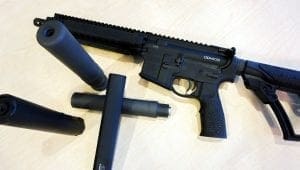 However, one platform that deserves more attention is the pistol-caliber carbine, or PCC, particularly when paired with a suppressor (Suppressed PCC).
While there is no perfect firearm for every person or every situation, a suppressed PCC offers several advantages that make it worth considering for home defense.
Why Not Just Use a Handgun?
The answer is simple: handguns are convenient, not easy. The primary advantage of a handgun is portability. We carry pistols because they are compact and practical to have on our person throughout the day. But when it comes to actually shooting, most people perform significantly better with a shoulder-fired firearm.
A carbine provides multiple points of contact with the body, making it easier to aim, easier to control, and easier to shoot accurately under stress. For the average homeowner, this often translates into faster, more accurate hits and greater confidence behind the firearm.
Simply put, most people can learn to shoot a carbine effectively faster than they can master a handgun.
Why a PCC?
One of the advantages of a pistol-caliber carbine is controllability. Modern 9mm defensive ammunition has a proven track record, and when fired from a carbine platform, recoil is typically mild and easy to manage. This allows shooters to maintain better control, make faster follow-up shots, and spend less effort fighting the gun.
For many homeowners, especially those who may not be dedicated firearms enthusiasts, that ease of use can be a significant advantage. A PCC also tends to be less intimidating for newer shooters while still providing ample capability for defensive use.
The Suppressor Advantage
When most people think about suppressors, they think about movies or specialized tactical applications. In reality, suppressors are safety equipment.
A defensive firearm will almost certainly be used indoors, in confined spaces, and without hearing protection. The noise and concussion produced by an unsuppressed firearm can be extreme and may cause immediate and permanent hearing damage.
A suppressor helps reduce blast and concussion while making communication easier during and after a defensive encounter. It can also reduce the disorientation that often accompanies firing a firearm in a confined space.
No suppressor makes a firearm “silent,” despite what Hollywood would have people believe. What it can do is make a very loud event somewhat more manageable for everyone involved.
The Bottom Line
No firearm is perfect, and every home-defense setup involves tradeoffs. Storage, maneuverability, recoil, capacity, training, and personal circumstances all play a role in determining what works best for an individual homeowner.
That said, a Suppressed PCC offers a compelling combination of shootability, controllability, and hearing protection that many people overlook.
At C2 Tactical, we encourage students to think beyond trends and internet debates and instead focus on what allows them to safely and effectively protect themselves and their families. Because the best home-defense firearm is not necessarily the most powerful one. It is the one you can access, control, and use effectively when it matters most.