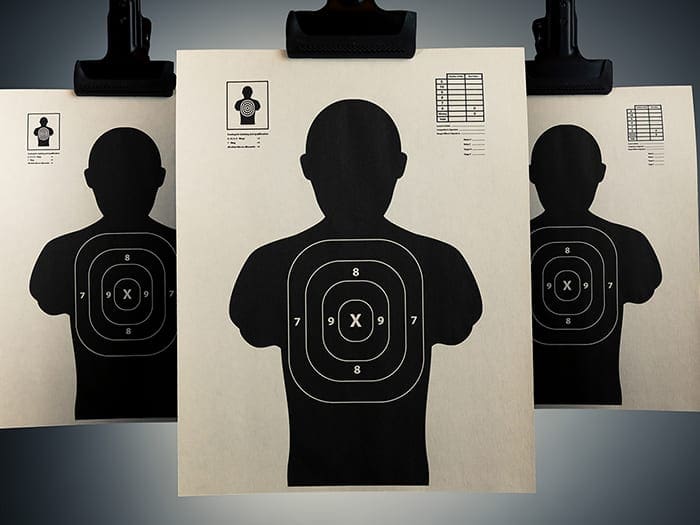
Most shooters look at their target to see where they hit. That’s understandable. After all, the basic objective of shooting is to put rounds where you intended them to go.
But a target can tell you considerably more than whether you hit the center.
The holes in the paper are a record of what happened at the gun. Group size, location, consistency and changes from one string to another can all provide information about what the shooter is doing. Learning to recognize that information is one of the most useful skills you can develop on the range.
We spend time on exactly this in our P200 class at C2 Tactical. We teach students how to “read the target” because once you begin understanding what the target is telling you, practice becomes much more productive.
Look for Patterns
One bad shot doesn’t necessarily tell you much. Everyone throws a round occasionally. What becomes interesting is when the same thing keeps happening.
If rounds consistently appear in a particular area, your group continues opening in the same direction, or accuracy deteriorates as you increase speed, something is happening at the gun. The target is giving you evidence.
That doesn’t mean we should immediately jump to conclusions.
You’ve probably seen those diagnostic targets claiming that every location corresponds to a particular shooting error. They’re useful as a starting point, but shooting isn’t quite that simple. A low-left group doesn’t automatically prove one specific problem. Grip, trigger manipulation, anticipation, sight movement and several other factors can produce similar results.
The target provides the clue. The shooter—or instructor—still has to diagnose the cause.
Change Something and Test It
This is where productive practice differs from simply firing ammunition.
If you believe you’ve identified a problem, change something and shoot again. Maybe you adjust your grip. Perhaps you slow down and concentrate on trigger movement. You might change your visual focus or reduce the distance temporarily.
Then look at the target. Did the group change? Did it tighten? Did the rounds move? Did the problem disappear only to return when you increased speed again?
Now you’re learning.
This process of observing, diagnosing, adjusting and testing is considerably more valuable than simply firing another magazine and hoping things improve. Repeating a mistake isn’t progress.
Make Every Round Give You Information
Round count alone isn’t a particularly useful measure of training. Someone can fire 200 rounds while repeating exactly the same mistake and leave the range having accomplished very little. Another shooter might fire 50 carefully considered rounds, make several adjustments and leave with a much better understanding of what needs work.
That doesn’t mean every shot needs to become an academic exercise. Shooting should still be enjoyable, and sometimes sending rounds downrange is exactly what you came to do.
But when you’re practicing with the intention of improving, pay attention to the information you’re receiving.
Before immediately covering the holes and loading another magazine, take a moment. Look at the group. Think about what you felt and saw while shooting it. Consider what might have produced the result, make an adjustment and see what happens next.
The target doesn’t know what you intended to do. It doesn’t care how expensive your firearm is or how well you shot last week.
It simply records what you actually did.
Learn to listen to it.